Benchmarks
 Under Construction
As of 9/13/26 this is a new section and is still being developed.
I think it's useful to look through comparisons between radiate and other libraries that share this space in terms of performance and efficiency. All benchmarks are run in python on a 2020 M1 Pro MacBook Pro. The code that created the below charts and comparisons can be found in the raidate-benchmarks repository on github.
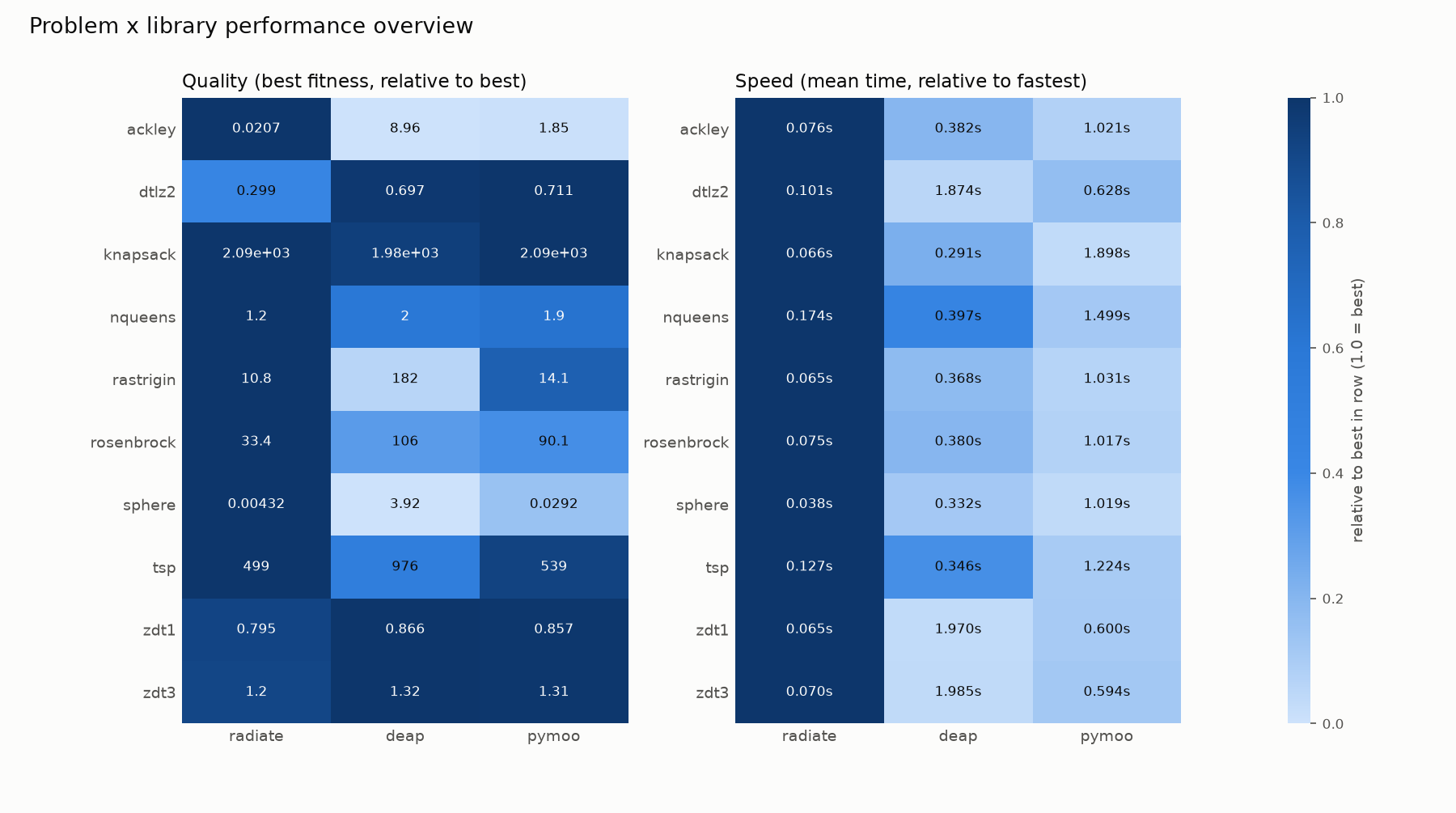
In the benchmark's project, we compare the performance and efficiency of radiate against other libraries like PyMoo and DEAP across various optimization problems. Below are the results of these simple problems, showing both the convergence quality & speed of the different libraries. Each library x problem combination is run 10 times, the best/worst/mean results & wall-clock times are recorded.
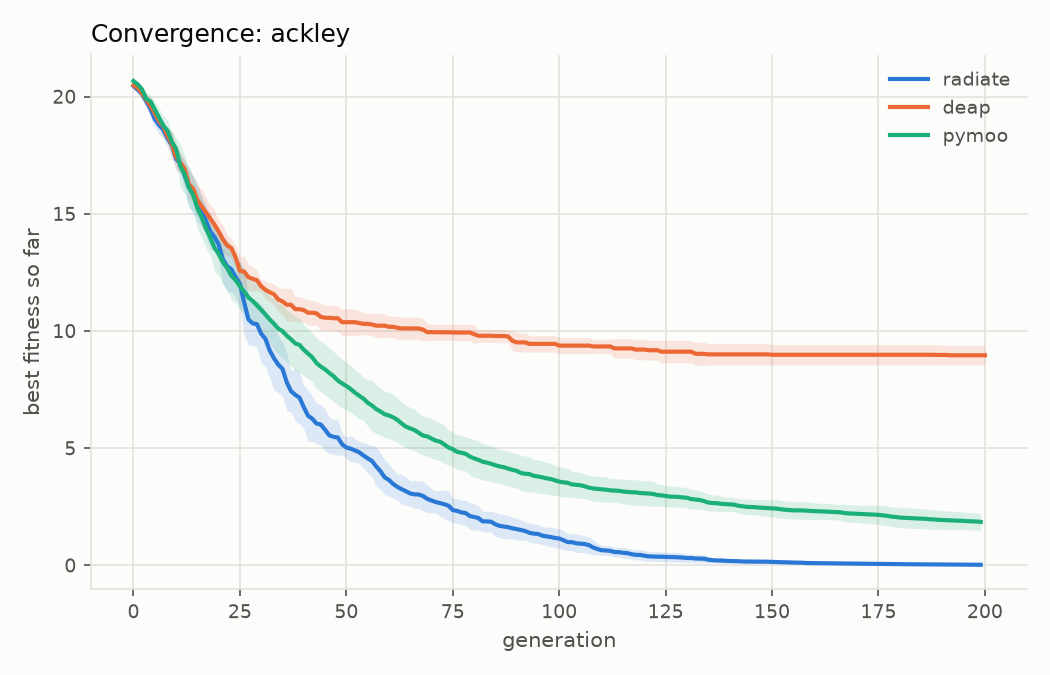
Ackley
Continuous optimization using f64 precision floating-point numbers & numpy arrays.
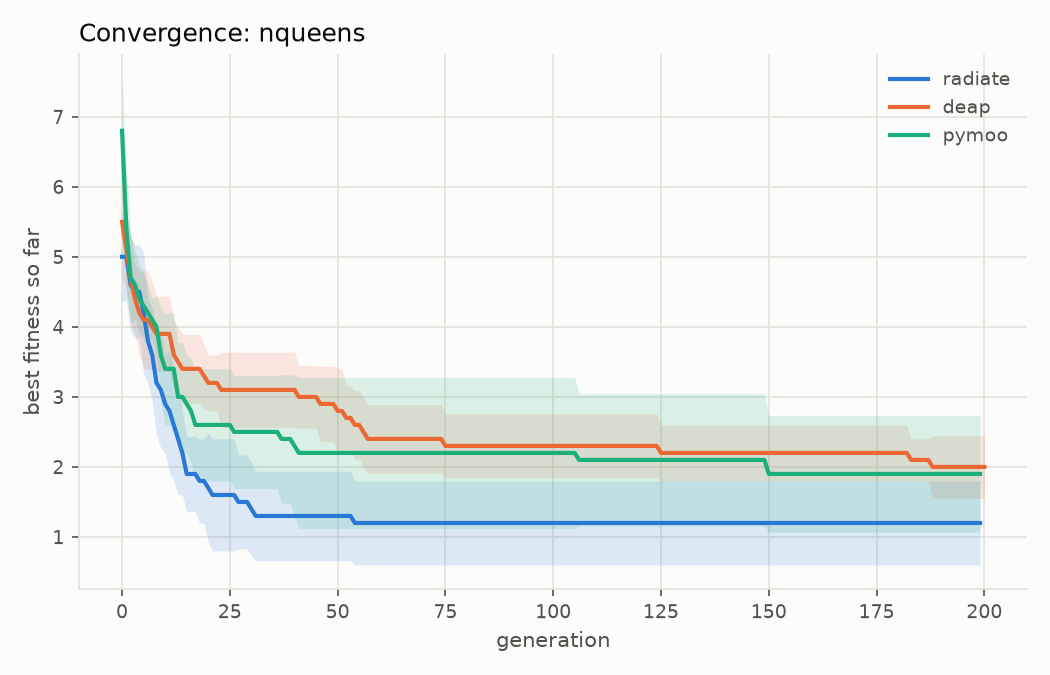
N-Queens
Discrete optimization using usize precision integers & numpy arrays. Radiate here is using the permutation codec.
Not using optimized radiate fitness function
There are other examples in this user guide (here) that will actually produce faster & more efficient results using radiate.
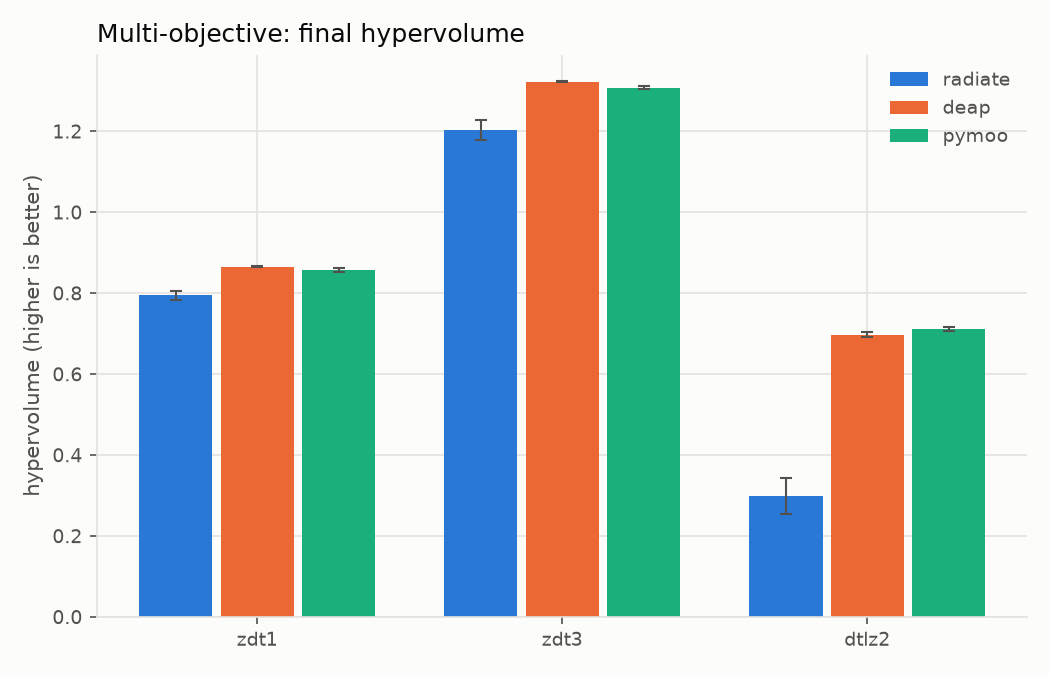
Multi-Objective Optimization
Below we can see the convergence of different hypervolume indicators for the zdt1, zdt3, and dtlz2 problems. These three are pretty common benchmarks for multi-objective optimization. Although radiate surpases the other two libraries in most of the other benchmarks, in terms of multi-objective hypervolume measures, it lags. This is an area I'm actively working on improving!
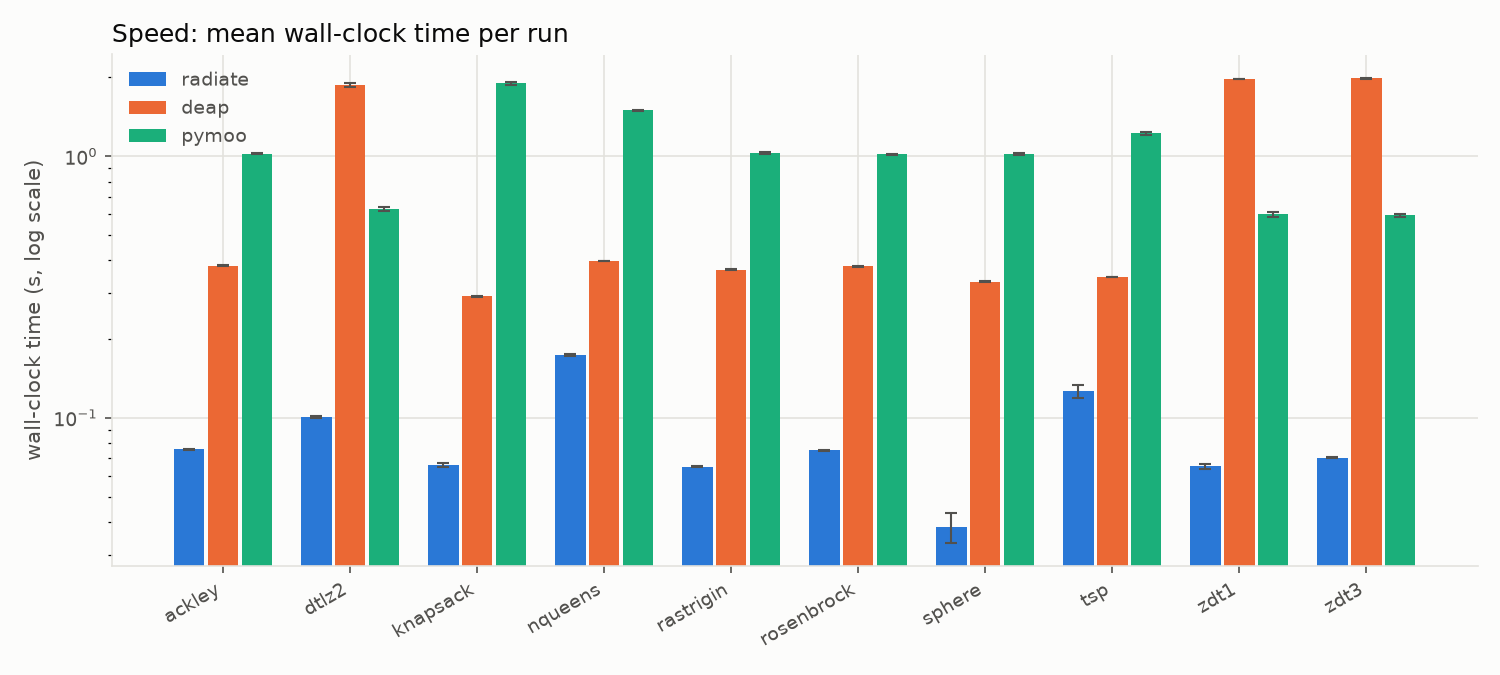
Speed
Although radiate lags on hypervolume measurements, it is still by far the fastest (~0.07–0.10s vs. 0.6–2.0s for the others) even where it loses on quality.
Below is a log normalized comparison of speed - some problems are just slower to converge so log scale is needed.
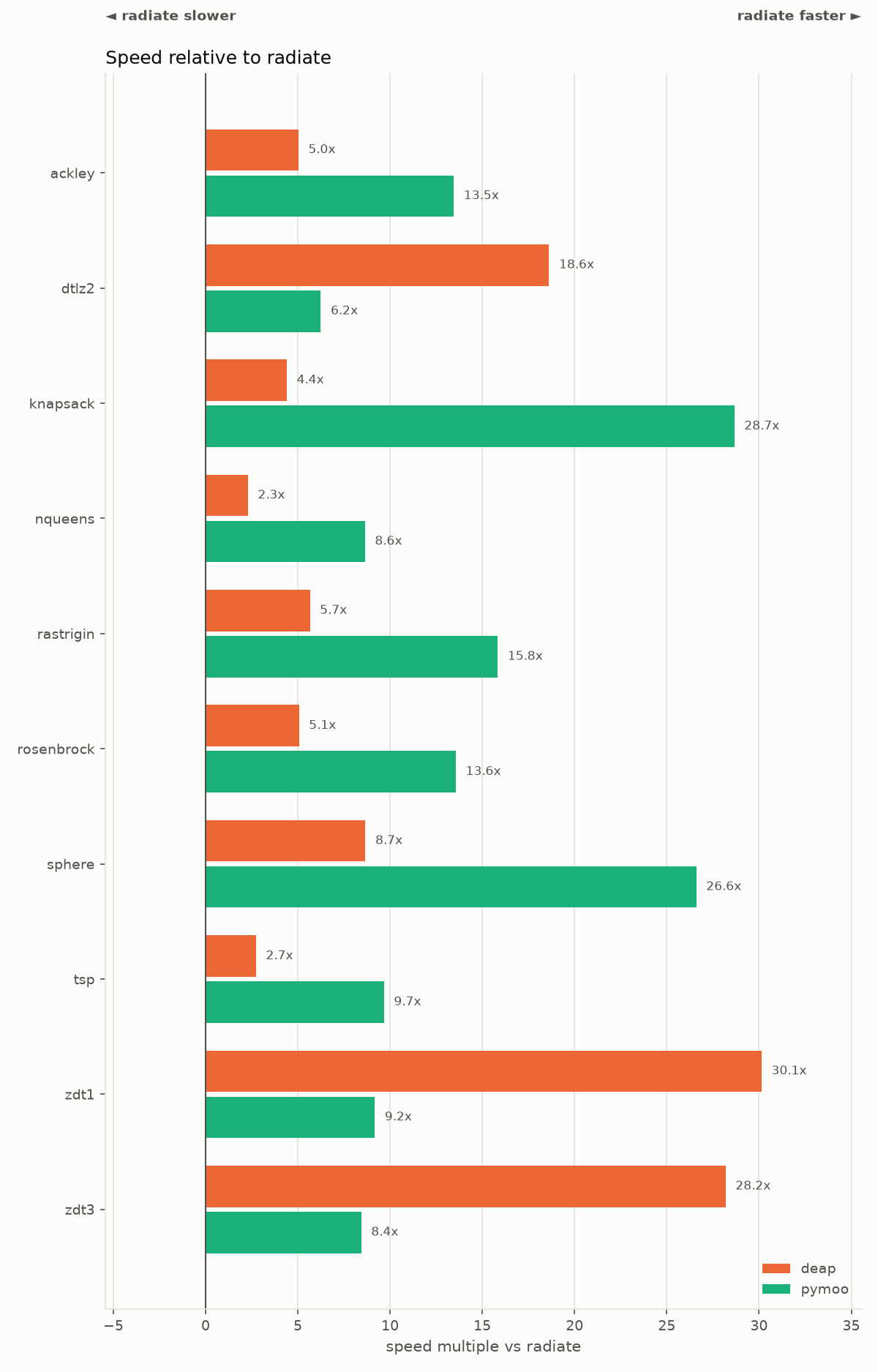
And now a raw comparison. Anything left of the black line indicates that radiate is slower vs the right side where radiate is faster & by how much.
Raw Results
| problem | library | best_mean | best_std | time_mean_s | time_std_s | n_trials |
|---|---|---|---|---|---|---|
| ackley | radiate | 0.0207 | 0.0106 | 0.0759 | 0.0003 | 10 |
| ackley | deap | 8.9594 | 0.4361 | 0.3816 | 0.0009 | 10 |
| ackley | pymoo | 1.8515 | 0.3751 | 1.0208 | 0.0051 | 10 |
| dtlz2 | radiate | 0.2990 | 0.0436 | 0.1007 | 0.0008 | 10 |
| dtlz2 | deap | 0.6974 | 0.0061 | 1.8741 | 0.0333 | 10 |
| dtlz2 | pymoo | 0.7111 | 0.0056 | 0.6284 | 0.0094 | 10 |
| knapsack | radiate | 2090.0000 | 0.0000 | 0.0662 | 0.0011 | 10 |
| knapsack | deap | 1982.4000 | 35.0498 | 0.2915 | 0.0008 | 10 |
| knapsack | pymoo | 2090.0000 | 0.0000 | 1.8980 | 0.0213 | 10 |
| nqueens | radiate | 1.2000 | 0.6325 | 0.1735 | 0.0017 | 10 |
| nqueens | deap | 2.0000 | 0.4714 | 0.3973 | 0.0012 | 10 |
| nqueens | pymoo | 1.9000 | 0.8756 | 1.4988 | 0.0052 | 10 |
| rastrigin | radiate | 10.8435 | 4.8314 | 0.0651 | 0.0003 | 10 |
| rastrigin | deap | 182.1082 | 14.1792 | 0.3682 | 0.0009 | 10 |
| rastrigin | pymoo | 14.1199 | 3.7540 | 1.0311 | 0.0114 | 10 |
| rosenbrock | radiate | 33.4129 | 14.9997 | 0.0750 | 0.0002 | 10 |
| rosenbrock | deap | 106.0411 | 4.8883 | 0.3795 | 0.0009 | 10 |
| rosenbrock | pymoo | 90.1068 | 23.4850 | 1.0173 | 0.0068 | 10 |
| sphere | radiate | 0.0043 | 0.0019 | 0.0383 | 0.0051 | 10 |
| sphere | deap | 3.9225 | 0.3664 | 0.3320 | 0.0007 | 10 |
| sphere | pymoo | 0.0292 | 0.0061 | 1.0192 | 0.0113 | 10 |
| tsp | radiate | 499.1356 | 12.1659 | 0.1266 | 0.0073 | 10 |
| tsp | deap | 975.7242 | 21.3226 | 0.3455 | 0.0010 | 10 |
| tsp | pymoo | 538.5293 | 54.1085 | 1.2235 | 0.0135 | 10 |
| zdt1 | radiate | 0.7949 | 0.0105 | 0.0654 | 0.0014 | 10 |
| zdt1 | deap | 0.8658 | 0.0006 | 1.9701 | 0.0039 | 10 |
| zdt1 | pymoo | 0.8568 | 0.0056 | 0.5995 | 0.0120 | 10 |
| zdt3 | radiate | 1.2043 | 0.0248 | 0.0704 | 0.0005 | 10 |
| zdt3 | deap | 1.3227 | 0.0010 | 1.9845 | 0.0108 | 10 |
| zdt3 | pymoo | 1.3079 | 0.0044 | 0.5940 | 0.0077 | 10 |