Alterers
Alterers are genetic operators that modify the genetic material of individuals in a population. In Radiate, there are two main types of alterers:
- Mutators: Operators that modify individual genes or chromosomes
- Crossovers: Operators that combine genetic material from two parents to create offspring
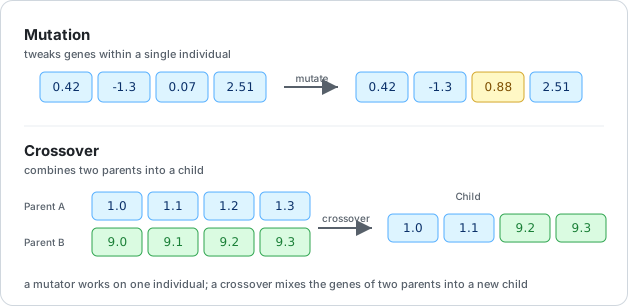
Alterers run during the engine's recombine step and are applied only to the offspring — the individuals chosen by the offspring selector. Survivors pass through to the next generation untouched. Each alterer is paired with a rate that controls how often it fires, so you tune not just which operators run but how aggressively.
These operators modify the population and are essential for the genetic algorithm to explore the search space effectively. As such, the choice of alterer can have a significant impact on the performance of the genetic algorithm, so it is important to choose an alterer that is well-suited to the problem being solved.
This section is organized as:
| Page | Covers |
|---|---|
| Rate | how often an alterer fires — a fixed value or a schedule that changes over the run |
| Mutators | operators that tweak genes within a single individual |
| Crossovers | operators that combine two parents into offspring |
| Example | wiring alterers into an engine |
Best Practices
-
Rate Selection:
- Start with conservative rates (0.01 for mutation, 0.5-0.8 for crossover)
- Adjust based on problem characteristics
- Higher rates increase exploration but may disrupt good solutions
-
Choosing the Right Alterer:
-
Combining Alterers:
- It's often beneficial to use multiple alterers
- Example: Combine a local search mutator (Gaussian) with a global search crossover (Multi-point)
- Monitor population diversity to ensure proper balance
-
Parameter Tuning:
- Start with default parameters
- Adjust based on problem size and complexity
- Use smaller rates for larger problems
Common Pitfalls
-
Too High Mutation Rates:
- Can lead to random search behavior
- May destroy good solutions before they can be exploited
- Solution: Start with low rates (0.01-0.1) and adjust based on results
-
Inappropriate Crossover Selection:
- Using permutation crossovers for continuous problems
- Using continuous crossovers for permutation problems
- Solution: Match the crossover type to your problem domain
-
Ignoring Problem Constraints:
- Some alterers may produce invalid solutions
- Solution: Use appropriate alterers or implement repair mechanisms
-
Poor Parameter Tuning:
- Using the same parameters for all problems
- Solution: Experiment with different parameters and monitor performance